
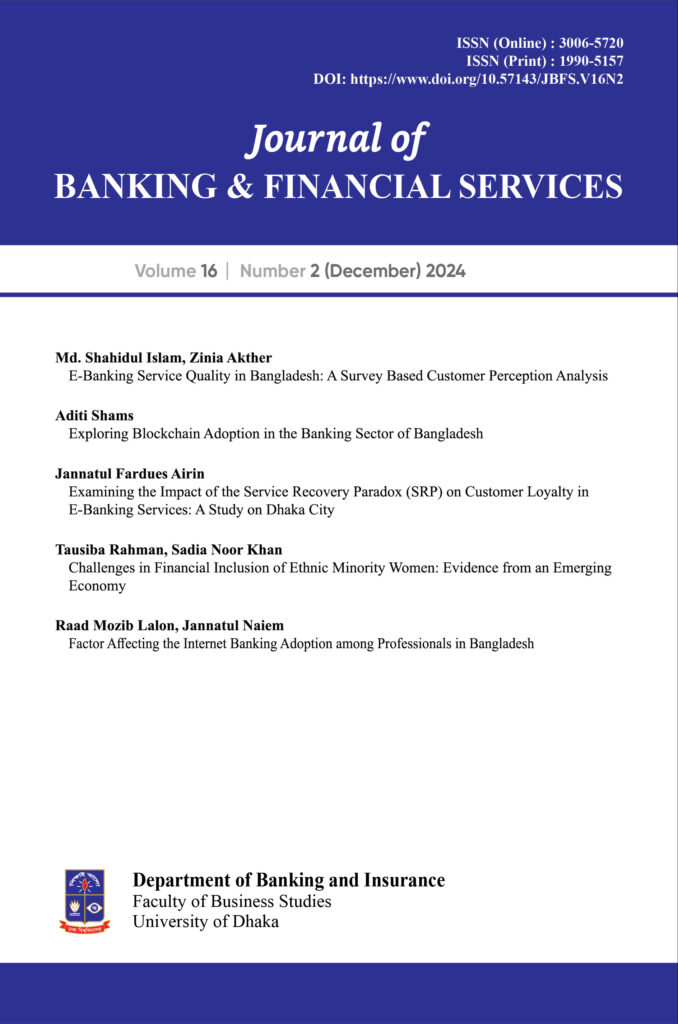
Author Details
Jannatul Fardues Airin
Lecturer, Department of Marketing,
University of Dhaka
Email: jannatul.fardues@du.ac.bd
Article Details
JBFS Volume 16 Number 2 (December) 2024
DOI: https://www.doi.org/10.57143/JBFS.V16N2A3
JEL Classifications: C3, G5, G32
Received: 31 December, 2024
Accepted: 19 March, 2025
Published online: 30 June, 2025
Published in Print: 30 June, 2025
ISSN (Online) 3006-5720
ISSN (Print) 1990-5157
Abstract
Abstract
The study objective is to examine the impact of service recovery paradox (SRP) toward customer loyalty in e-banking services in Dhaka, Bangladesh. The current study has applied service recovery paradox (SRP) theory to construct a model with three factors: compensation, communication gap reduction, and complaint handling which turns frustrated customers into loyal customers. This study used convenience sampling techniques to select the respondent. A total of 200 respondents were participated in this study but only 175 responses were used for analysis after screening the data. For analyzing the data and testing the hypotheses, this study used frequency distribution and structural equation modeling (SEM). The findings of this study demonstrated that three exogenous variables (compensation, communication gap reduction, and complaint handling) statistically significant in influencing customer loyalty of e-banking services in Bangladesh. This study also showed complaint handling influences customer loyalty more than the communication gap reduction and compensation. Finally, this study findings provide some meaningful implications that help service provider to improve customer loyalty considering other unexplained factors.